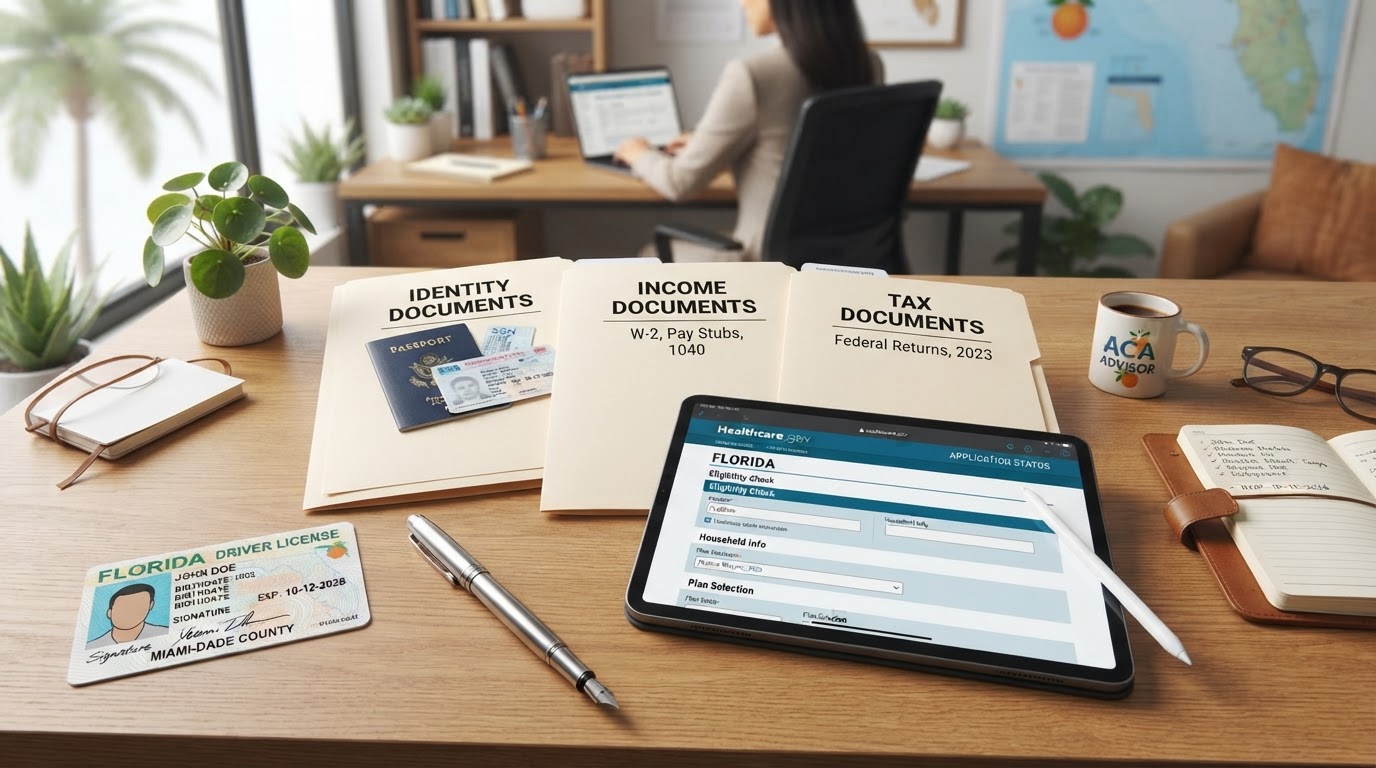






What Documents Do You Need for ACA Marketplace in Florida?
Gathering your ACA application documents before you sit down to apply on Florida's Health Insurance Marketplace can save you hours of frustration — and potentially thousands of dollars in subsidies. Florida uses the federally-facilitated Marketplace at HealthCare.gov, meaning your application is processed by the federal government rather than a state-run exchange. Getting the right paperwork together upfront ensures your income is verified accurately, your household size is counted correctly, and you receive every dollar of premium tax credit you qualify for. Whether you're applying during Open Enrollment or a Special Enrollment Period, this guide covers every document you'll need.
Why Having the Right Documents Matters in Florida
Florida has one of the highest ACA Marketplace enrollment rates in the country — consistently ranking first among all states in new and returning enrollees. That also means the federal Marketplace processes a massive volume of applications from Florida residents each year, and errors or missing information can trigger verification holds that delay your coverage start date.
When your documents don't match what the IRS has on file, the Marketplace may place you in a "pending" status while it verifies your identity or income. During that window, you could be uninsured or paying full premiums without a subsidy. Submitting accurate, complete documentation from day one avoids those delays and protects your coverage.
Beyond enrollment speed, documents directly affect your premium tax credit (also called an advance premium tax credit, or APTC). Your subsidy is calculated based on your projected Modified Adjusted Gross Income (MAGI) for the coverage year. Underreporting or overreporting income can lead to a surprise tax bill — or leaving money on the table. Florida residents earning between 100% and 400% of the Federal Poverty Level (FPL) — and in some cases up to any income level due to temporary ARP provisions — may qualify for subsidies, so getting your income documentation right is critical.
ACA Application Documents Florida Residents Must Gather
Here's a comprehensive breakdown of every document category you should prepare before starting your HealthCare.gov application.
1. Proof of Identity
You'll need to verify who you are when creating your HealthCare.gov account and completing your application. Acceptable forms of identity documentation include:
- U.S. passport (current or expired within the last year)
- Driver's license or state-issued ID (Florida REAL ID accepted)
- Birth certificate combined with a government-issued photo ID
- Social Security card (used alongside another photo ID)
- Military ID or Veterans Affairs ID
Your full legal name on all documents must match exactly what you enter in your application. Even minor discrepancies — a middle name included vs. omitted — can trigger an identity verification flag.
2. Social Security Numbers (SSNs)
You'll need the Social Security Number for every person being added to the health plan, including children and any dependents. If a household member doesn't have an SSN (for example, a non-citizen who is lawfully present), they can still be included on the application, but you'll need their Immigration document numbers instead (see below).
3. Immigration and Citizenship Documents
For non-U.S. citizens who are lawfully present and wish to enroll, you'll need one of the following:
- Permanent Resident Card (Green Card)
- Employment Authorization Card
- Visa documents (such as H-1B, H-4, or F-1 status documentation)
- I-94 Arrival/Departure Record
- Certificate of Citizenship or Naturalization
Undocumented immigrants are not eligible to purchase plans through the ACA Marketplace, but their U.S. citizen or lawfully present family members can still enroll separately.
4. Proof of Income — The Most Important ACA Application Document
This is where most Florida applicants run into trouble. Your income documentation determines your subsidy amount, your plan options, and whether you qualify for Florida Medicaid instead of a Marketplace plan.
For W-2 employees:
- Most recent federal tax return (Form 1040)
- Recent pay stubs (last 2–3 pay periods)
- W-2 forms from the prior tax year
For self-employed Floridians:
- Most recent tax return with Schedule C
- Profit-and-loss statement for the current year
- Bank statements showing business deposits (if income has changed)
For other income types:
- Social Security award letters (for SSI, SSDI, or retirement income)
- Pension or retirement account statements
- Alimony documentation (for divorces finalized before Jan. 1, 2019)
- Unemployment benefit letters
- Rental income documentation
Key Florida note: Florida did not expand Medicaid under the ACA, so adults without dependent children who earn below 100% FPL (approximately $15,060/year for a single person in 2025) fall into a coverage gap — they don't qualify for Medicaid and don't qualify for Marketplace subsidies. Accurately documenting your income is essential to understanding exactly where you land.
If your income is variable or you're newly self-employed, your agent at GetCoveredFL.com can help you calculate a reasonable income estimate that minimizes your risk of an end-of-year repayment.
Household and Dependent Documentation
Your household size directly impacts your subsidy calculation. The ACA uses a specific definition of "household" for tax purposes, which is based on who you claim on your federal tax return — not necessarily who lives in your home.
Documents to Verify Household Members
- Birth certificates for dependent children
- Adoption paperwork for adopted children
- Marriage certificate for a spouse
- Divorce decree if relevant to custody arrangements
- Foster care documentation if applicable
For family health insurance coverage in Florida, you'll need to add each dependent individually. Make sure each child's name and date of birth matches exactly what's on their birth certificate or Social Security records.
Employer Coverage and Other Health Insurance Documents
If you or a family member has access to employer-sponsored health insurance, you may still be eligible to purchase a Marketplace plan — but you'll only qualify for subsidies if the employer plan doesn't meet ACA minimum value and affordability standards.
What You'll Need:
- A letter or documentation from your employer showing the cost of the lowest-cost self-only plan and whether it meets minimum value requirements
- If you're leaving a job, a COBRA election notice showing the coverage end date
- Documentation of any other coverage you're losing (triggers a Special Enrollment Period)
If you're comparing your employer plan against Marketplace options, our guide to comparing health insurance plans in Florida can help you weigh the costs side by side.
Documents You'll Need If You Have a Life Event
Outside of the annual Open Enrollment Period (November 1 – January 15 in Florida), you can only enroll or make changes through a Special Enrollment Period (SEP) triggered by a qualifying life event. Each event requires its own documentation:
- Loss of coverage → Termination letter from your prior insurer, or COBRA notice
- Marriage → Marriage certificate
- Birth or adoption → Birth certificate or adoption paperwork
- Relocation → Proof of prior and new address (utility bills, lease agreements)
- Income change → Updated pay stubs, employer letter, or tax documents
- Gaining citizenship or lawful status → Immigration documents listed above
You typically have 60 days from the qualifying event to submit your application and supporting documents. Missing that window means waiting until next Open Enrollment. Learn more about SEP deadlines in our Special Enrollment Period Florida guide.
Quick-Reference Document Checklist for Florida ACA Applications
Use this checklist before starting your HealthCare.gov application:
| Document Category | What to Gather |
|---|---|
| Identity | Driver's license, passport, or state ID |
| Social Security | SSN for every household member enrolling |
| Immigration | Green card, visa, or I-94 (if applicable) |
| Income | Tax return, pay stubs, W-2, or Schedule C |
| Household | Birth certificates, marriage/divorce records |
| Employer Coverage | Employer coverage letter, COBRA notice |
| Life Events | Documentation specific to your qualifying event |
How to Submit Your ACA Documents in Florida
Once your application is submitted on HealthCare.gov, the Marketplace will notify you if additional verification is needed — usually within a few days. You can upload documents directly through your HealthCare.gov account portal, mail them to the address listed in your notice, or fax them.
Important: The Marketplace typically gives you 90 days to resolve a data-matching issue before your eligibility is affected. Don't ignore those notices — they can result in loss of your subsidy or even termination of your plan.
If you're unsure how to upload documents or your application is flagged for verification, a licensed agent at GetCoveredFL.com can walk you through the process at no cost to you. Agents are paid by the insurance carriers — not by you — so there's never a fee for our assistance.
Related Reading
- ACA Metal Tiers Florida: Bronze, Silver & Gold Guide
- ACA Open Enrollment Florida 2026: Dates & Deadlines
- Special Enrollment Period Florida: Your Complete Guide
Get Help With Your Florida ACA Application Today
Gathering your ACA application documents in Florida doesn't have to be stressful. When you work with a licensed Florida insurance agent, you get a knowledgeable partner who can verify your income estimate, match you to the right Marketplace plan, and make sure your application is complete before you submit it.
Visit GetCoveredFL.com to compare plans and get a free quote, or call us at (855) 634-5343 to speak directly with a licensed Florida agent. We serve clients across Miami-Dade, Broward, Palm Beach, Hillsborough, Orange County, and statewide.
Top-Rated Carriers
- A+ rating
- BBB accredited business
- Customer recommended
Frequently Asked Questions
What documents do I need to apply for ACA Marketplace coverage in Florida?
You'll need a government-issued photo ID, Social Security numbers for all household members enrolling, proof of income (such as tax returns and pay stubs), and documentation of any qualifying life events. Non-citizens should also have immigration documents ready. Having these ready before starting your HealthCare.gov application prevents delays and verification holds.
Does Florida have its own ACA Marketplace, or do I use HealthCare.gov?
Florida uses the federally-facilitated Marketplace, so all ACA applications are completed at HealthCare.gov — not a state-run exchange. This means your enrollment, subsidy calculations, and document submissions are all handled through the federal portal. A licensed Florida agent can still assist you through the entire process at no extra charge.
What income documents do self-employed Floridians need for ACA enrollment?
Self-employed Florida residents should prepare their most recent federal tax return with Schedule C, a current year profit-and-loss statement, and recent bank statements if income has changed significantly. Since self-employment income can be unpredictable, working with an agent to calculate an accurate projected annual income is strongly recommended to avoid end-of-year tax credit repayments.
Can I still get an ACA subsidy if I have employer-sponsored insurance in Florida?
You may qualify for a Marketplace subsidy even if your employer offers coverage — but only if the employer plan is considered unaffordable (meaning the employee-only premium exceeds roughly 9.02% of your household income in 2025) or doesn't meet ACA minimum value standards. You'll need a letter from your employer documenting the plan cost and benefits to verify this on your application.
What happens if I don't submit required documents after applying in Florida?
If the Marketplace flags your application for a data-matching issue and you don't respond with the required documents, you risk losing your premium tax credit or having your plan terminated. The Marketplace usually gives you 90 days to resolve these issues. Check your HealthCare.gov account regularly for notices, and contact GetCoveredFL.com or call (855) 634-5343 if you need help responding quickly.
Ready to find your plan?
Get free quotes from licensed Florida agents in minutes.